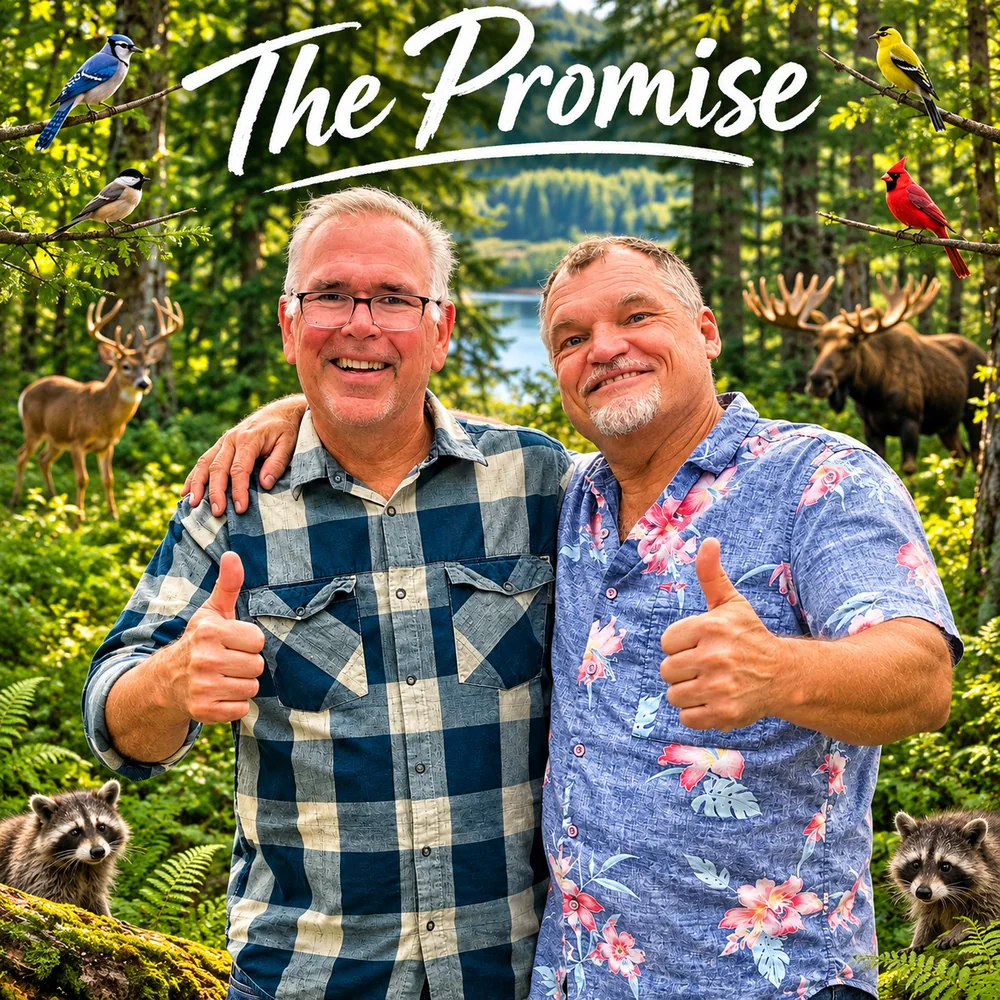
The friendship, the forest, and the promise that grew into something bigger.
Best friends have conversations that most people would probably find a little uncomfortable. Eventually, somewhere between reminiscing about the good old days and wondering how many more good days we have left, the subject of mortality comes up.
What happens when we get old? What happens if one of us becomes seriously ill? And just how far would we go to help each other?
Many years ago, my best friend Ryan and I had one of those conversations.
We made a pact. Half serious, half joking, we agreed that if either of us ever became terminally ill, with no hope of recovery and nothing but suffering ahead, the other would take him for one last walk into the woods, carrying a loaded gun, and put him out of his misery.
Now, before anyone gets too concerned, neither of us even owns a gun! It wasn't exactly a well-thought-out plan, and we certainly weren't drawing up instructions.
This was long before Canada introduced Medical Assistance in Dying (MAID), which now provides a regulated medical option for eligible people facing intolerable suffering.
But the conversation was never really about the gun, the woods, or even death.
It was about the promise.
It was about knowing that when life became unbearable, neither of us would have to face it alone. It was about the kind of friendship where you don't need to ask whether someone has your back. You already know the answer.
And that's where the chorus comes from:
My best friend and I made a promise a long time ago, together we made a pact...
The years passed, and what began as a darkly humorous conversation between two friends eventually took on a much deeper meaning.
At the time I wrote this song, two other friends had been diagnosed with cancer. Their situations appeared terribly serious, and the possibility of losing them was devastating.
Thankfully, both underwent intensive treatment, and their cancers went into remission. But during that frightening period, the uncertainty was overwhelming. My heart was gutted.
Suddenly, mortality wasn't some distant philosophical discussion. It was right there, staring us in the face.
That's where the forest imagery entered the song.
It seems like lately that so many all around. Like old forest growth, we're being cut down.
I began thinking of the people in our lives as trees in an old forest. Some have stood for decades, weathering storms, growing stronger, spreading their branches and providing shelter for others.
Each tree has its own history. Its own scars. Its own place in the forest.
And then, one by one, they begin to fall.
Sometimes it's age. Sometimes it's illness. Sometimes it's something completely unexpected.
We watch people we've known and loved slowly lose their strength, their independence, and occasionally their dignity. It's painful to witness, especially when there's so little we can do to change the outcome.
The reference to a ship heading out to sea reflects that helplessness. We can stand on the shore and watch someone drift farther away, knowing there may come a point when we can no longer reach them.
But the song isn't suggesting that we should simply cut down the trees that are struggling or discard people whose lives have become difficult.
Quite the opposite.
The forest is worth protecting, especially its most vulnerable trees.
The song also explores another question that has fascinated humanity for as long as we've been capable of asking it.
What happens when we die?
Are we simply gone? Does our consciousness end? Or does something of us continue, perhaps in another life, another form, or another existence?
Is our spirit passed on to new seeds in the forest, or just dead and gone like those that came before us?
The seeds represent the possibility of something continuing beyond our physical lives.
Some people believe in reincarnation. Others believe in heaven, an afterlife, or some other spiritual existence. Still others believe that death is the end of individual consciousness.
I don't pretend to know the answer.
And I don't think the song needs to provide one.
There's another kind of continuation we can actually see.
Our influence lives on through the people we've loved, the kindness we've shown, the lessons we've passed along, and the memories we've helped create.
Like a fallen tree that nourishes the forest floor, perhaps something of us continues to help others grow long after we're gone.
The references to carving names into trees, stories fading away, and dates on gravestones are reminders of how temporary our physical existence really is.
We spend our lives accumulating experiences, building relationships, making mistakes, achieving things, and telling stories.
Eventually, many of those stories disappear.
A whole lifetime can be reduced to a name and two dates carved into a stone.
But what happens between those dates is what really matters.
And that brings me to the heart of the song.
If we can't know for certain what happens after death, perhaps we should spend a little more time thinking about what we can do while we're alive.
There are people around us who are frightened, lonely, sick, grieving, or simply struggling to get through another day.
Some are fighting battles we know nothing about.
The lyric "We're all warm-blooded friends around here, but some of us get cold" is a reminder that although we share the same basic human needs, not everyone has the warmth, comfort, or support they deserve.
Sometimes all it takes is a phone call, a visit, a helping hand, or simply showing someone that they haven't been forgotten.
The image of being someone's "life tree" brings the forest metaphor full circle.
A healthy tree provides shade, shelter, stability, and nourishment. We can do the same for one another.
We can't always cure an illness, stop someone from aging, or prevent the inevitable.
But we can make the journey a little less frightening and a lot less lonely.
And we can extend that kindness beyond our closest friends.
The promise Ryan and I made all those years ago was originally between two buddies who figured they could count on each other no matter what.
By the end of the song, that promise has grown into something much bigger.
It's no longer just about two friends.
It's about all of us.
It's about caring for the elderly, comforting the sick, supporting survivors, helping people who are struggling, and remembering that compassion is something we can actually put into practice.
We don't have to agree about religion, politics, or what happens after we die to agree that people deserve kindness while they're here.
The final words are deliberately simple.
In the name of humanity, be kind, take care, and promise...
Watch over others...
Take care of yourself...
Thank you.
That's really what The Promise is about.
Not death, but how we choose to live.
Not the fear of losing someone, but the importance of being there while we still have each other.
And not just making promises, but keeping them.
Because in the end, maybe the greatest thing we can leave behind isn't our name carved into a tree or a stone.
Maybe it's the shelter we provided, the lives we touched, and the people who knew they could always count on us.
That's a promise worth making.
And keeping.
— Andy